
My Approach
Most businesses don’t struggle because people aren’t working hard.
They struggle because direction, decisions, operations, and financial resources are not fully integrated.
My approach is built around bringing those pieces together—so the business can operate as a cohesive, aligned system.
My Goal
My goal is simple:
Help organizations become more intentional, integrated, and effective.
To help founders make better decisions through greater financial clarity. To increase alignment between financial resources, operations, and long-term objectives. To create organizations with more autonomy, accountability, purpose, and collaboration while reducing unnecessary complexity and waste.
To help businesses move from reactive to intentional, scattered to aligned, and from merely efficient to truly effective.
How I Think About Businesses
A business works best when it is clear on where it’s going, how decisions are made, and how resources are used to support that direction.
When those things are disconnected, the result is friction—confusion, reactivity, and constant course correction.
The goal is clarity and alignment across everything the business does.
My strategic advisory system
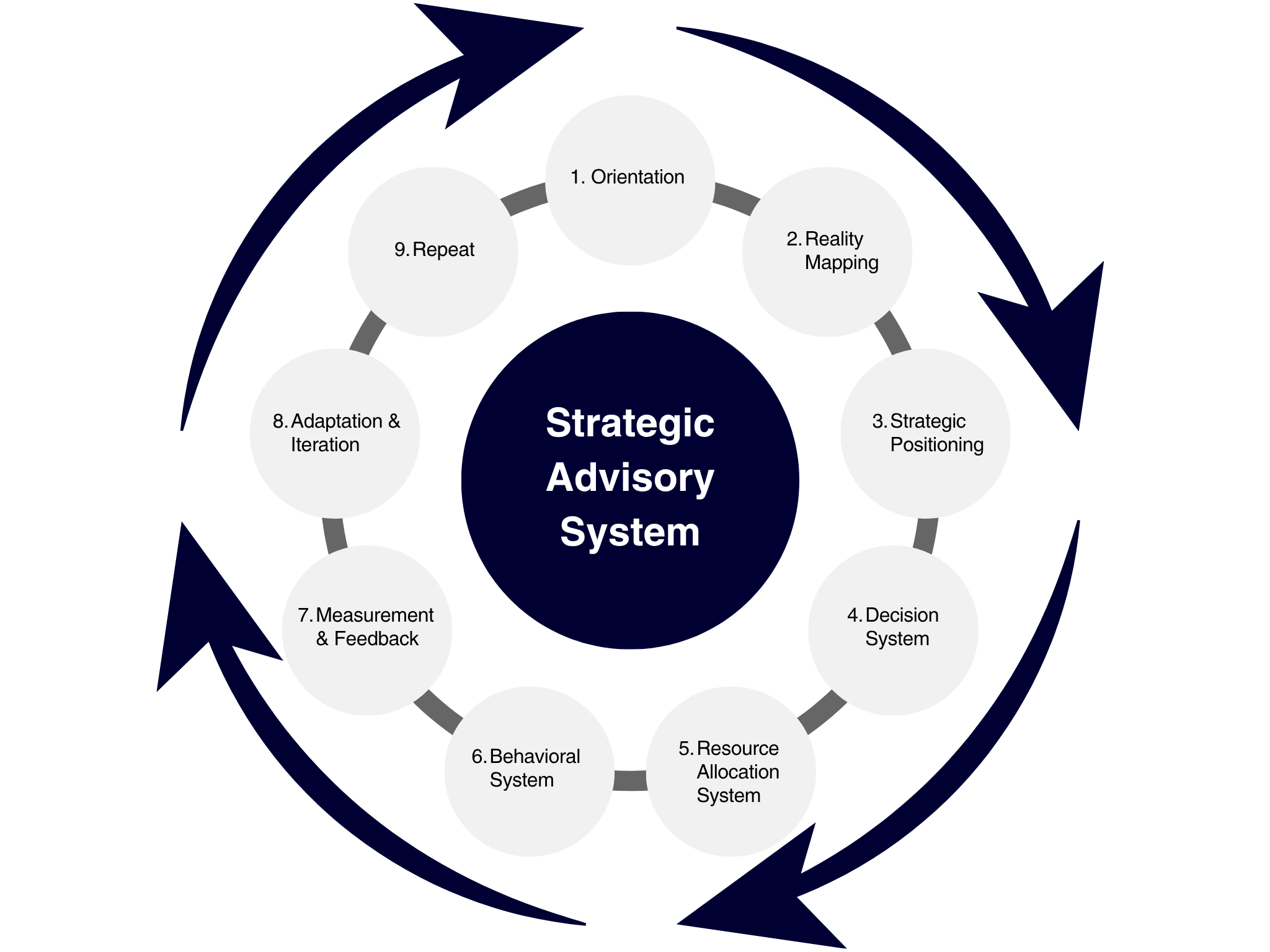
My work follows a structured, but flexible system that connects direction, decisions, execution, and feedback into a continuous loop.
Orientation: Understand the business, the founder, and the current reality.
Reality Mapping: Get clear on how the business actually operates today.
Strategic Positioning: Define where the business is going and “where to play”.
Decision System Design: Establish how decisions are made across the business and “how to play”.
Resource Allocation System: Align time, money, and effort with priorities.
Behavioral System: Translate direction into how people operate day to day.
Measurement & Feedback: Track what matters and compare to expectations.
Adaptation & Iteration: Adjust based on reality and continue improving.
My Key Unique Professional Practical Skills
Organizational Integration: Alignment to purpose, coherence, systems thinking, tradeoffs management, resource allocation, reducing fragmentation, integration, intentionality
Translating Strategy into Operational Reality: Connecting purpose to workflows, positioning, staffing, budgets, operations, incentive structures, resource allocation, execution realities
Reality-Based Judgment: Direct observation, seeing organizations as living systems, understanding practical consequences, visualizing workflows
Identifying Waste, Friction, and Bureaucracy: Naturally sensitive to unnecessary complexity, low-value work, organizational friction, disconnected meetings, incentive contradictions, inefficient resource allocation. Restoring clarity, simplicity, alignment, autonomy. Increasing effectiveness, collaboration, autonomy, and creativity. Decreasing rules and utility-based organizations. Making organizations more effective and human.
Integrating Human and Economic Reality: Valuing markets, entrepreneurship, economic coordination, value creation, operational effectiveness, profit, while simultaneously caring about: human flourishing, autonomy, meaning, trust, non-bureaucratic environments, internal value.
Founder Reality Experience: Understand constraints, tradeoffs, pressure, ambiguity, cash reality, operational burden.
Long-Term Integrative Thinking: Naturally think systemically, philosophically, longterm, pattern recognition. Slow down chaos, prioritize, integrate competing pressures, think beyond immediate fires, organize complexity coherently.
Practical Wisdom Orientation: Naturally driven toward understanding what matters, ordering competing goods properly, balancing tradeoffs, perceiving reality clearly, integrating principles with circumstances, creating coherent action.
From Individuals to Organizations
Underneath my system is a simple idea:
The way an individual operates and the way a business operates are not that different.
Both require clarity, sound judgment, alignment, and consistent action.
This perspective shapes how I think about building businesses—not just as machines for growth, but as systems that people operate within every day.
At an individual level, effectiveness comes from clear thinking, sound judgment, and consistent action.
In a business, the same idea applies—but at a larger scale.
An effective organization is not just one with goals. It’s one where:
Direction is clear
Decisions are made consistently, with application of principles and proper judgment based on current circumstances
People understand what matters
Behavior reflects priorities
Without that, even strong teams end up working against themselves.
My Philosophical Framework for Individuals & Businesses
Individuals
Ultimate End State
Eudaemonia: Human Flourishing
Foundational Traits
Practical Wisdom - Excellence of Character
Practices
Chosen, socially established pursuits as avenues of development and meaning
Domains of Excellence (Within Practices)
The Intellectual - The lover of Truth: Principles & Practical Wisdom
The Aesthetic - The lover of Beauty: Creativity, Culture, & Nature
The Moral - The lover of The Good: Virtue, Excellence, & Cooperation
The Spiritual - The lover of Unity: Depth, Connectedness, & Integrity
The Adventurer - The lover of Courage: The Human Will & Curiosity
Internal Goods
Priority pursuit and intrinsic motivation of practice participation. Intrinsic, communal, non-competitive rewards only attainable through the specific practices: excellence, enjoyment, meaning, experiences, satisfaction, expression, connection, collaboration, unity, civic involvement, pride, curiosity, will, discipline, etc
External Goods
Chosen External Goods: Money (not wealth creation for its own sake), resources, health, and close relationships are used to support the sustainable pursuit of practices. Also, external objectives are used to structure the participation of practices when necessary.
Social Organizations (Businesses)
Ultimate Objective
Sustainable Cooperative Flourishing: Creation of long-term value, purpose, and well-being for all stakeholders
Foundational Traits
Proper Decision Making - Excellence of Culture
Practice (The Organization)
The art of the social organization. The art of culture-building, managing risks and trade-offs, effective decision-making, efficiency, maximizing strengths, managing both focus and adaptability, and creating profit (which is really just total value created for the world minus the resources consumed to create that value). The organization of people and resources to provide an avenue for people to come together and participate in a common cause of creating long-term value, purpose, and well-being for all stakeholders. Creating in itself a practice for individuals to pursue their development, meaning, growth, and purpose.
Domains of Excellence (Within Organizations)
Intellectual - Provider of Truth & Transparency: Transparency & honesty for all stakeholders. An avenue to apply principles against the specific context, circumstances, and external environment by layering proper judgment in decision-making. These decisions within social organizations usually provide direct feedback based on the results of these decisions. Avenue for decision-making & autonomy to be available to varying degrees to all stakeholders.
Aesthetic - Provider of Beauty & Creativity: Excellent provider of creative opportunities. Should encourage intelligent risk-taking and creative autonomy for all stakeholders. The social organization combines individual strengths and creativity to provide something to the world that no one person could ever accomplish. Can also be a direct creator of beauty, whether through organized civic engagements, architecture, a new beautiful product, or even just an aesthetic internal working environment.
Moral - Provider of The Good: Integrity. Creating the organization’s statement of long-term values, purpose, and well-being for all stakeholders and aligning actions every day to these stated values. To do what you say. To align every aspect of the organization (objectives, decisions, relationships, employee incentives, definitions of success, resource allocation) to these stated values while feeling the pull of the “standard” organization metrics of success: revenue, size, market share, etc. To trade off, if necessary, short-term gains for long-term values. To create a culture that allows all stakeholders to properly pursue their personal growth, excellence, and collaboration.
Spiritual - Provider of Unity: A culture of individuals with the autonomy, direction, and support to discover and meaningfully pursue their unique creative strengths, which create depth and meaning to their lives. To create an atmosphere of collaboration, unity, and teamwork under a shared, mutual vision.
Wildcard - I call this the wildcard. For me, it’s The Adventurer. The four main domains are Intellectual, Aesthetic, Moral, & Spiritual, which pursue Truth, Beauty, Goodness, & Unity. However, there is an opportunity here for even deeper expressions of individual preferences. These could be an added source of meaning and purpose for certain stakeholders with certain preferences. An organization could be a provider of adventure for those who seek courage, fortitude, and curiosity; Science organizations and tech startups, for example. Some have a deep desire to help others; civic organizations can be a great avenue for this. For those who feel a deep calling to protect our planet and its resources, there are many both non-profit and for-profit organizations that align their values toward this. A calling toward justice: lawyer firms, police stations, etc.
Intrinsic Motivation & Rewards
The internal goods of social organization participation. Intrinsic, communal, non-competitive rewards only attainable through the stakeholder’s involvement with the organization: growth, enjoyment, meaning, experiences, satisfaction, expression, autonomy, belonging, connection, collaboration, unity, civic involvement, pride, curiosity, will, discipline, etc. In a proper organizational culture, these are the main “motivators” or rewards for the stakeholders, especially the employees or team involved.
External Goods
Chosen external objectives used to make the social organization sustainable. External objectives can also be used to help align the organization’s direction and compare quantifiable growth. In my opinion, in certain circumstances, there’s nothing wrong with using profit as an external metric. Profit really is just the total value an organization provided to the world minus the resources the organization consumed in creating that value. That is one of the potentially great things about for-profit social organizations: they can both for their stakeholders involved create purpose, meaning, and unity, while also combining the art of organizing individuals’ strengths, resources, focus, and decision-making under a shared mutual vision, which then can provide immense value to the community or world. However, attempting to keep and motivate the best people via external rewards such as individual bonuses instead of focusing on creating an environment for them where they can obtain intrinsic rewards (Mastery: utilizing their strength while also challenging them so they can feel the rewards of mastery and growth, Autonomy: the trust they should feel when given transparency and provided support without being micromanaged, Purpose: the feeling of being a part of something big and noble, Belonging: the importance of teamwork & togetherness) is a recipe for high turnover, a weak culture, and mediocre talent.
From Direction to Execution: What this means in a business
This is not theoretical—it directly affects how a business operates.
Direction: What the business is trying to become and what matters most. Clear priorities that guide decisions.
Decision-Making: Consistency in how choices are made across the business.
Alignment: People, systems, and financial resources supporting the same direction.
Execution: Day-to-day work that reflects what actually matters.
Strategy, Finance, and Execution Belong Together
Strategy without execution are just plans.
Finance without context are just numbers.
Execution without direction is just busy work.
These are not separate functions—they are parts of the same system.
When they are connected, the business becomes easier to operate, easier to understand, and easier to improve. The business becomes both focused and agile.
Proper strategy involves crafting the subtle relationship between thought and action, control and learning, stability and change, principles and context.
What This Looks Like
Clear priorities that guide day-to-day work
Fewer disconnected initiatives
Decisions tied to direction, not urgency
Financial visibility that actually supports action
Teams aligned around what matters
Regular review and adjustment instead of reactive change
How This Translates to Working Together
This approach is applied directly within the business through ongoing advisory work.
If you're looking to bring this level of clarity and alignment into your business, the next step is to start a conversation.